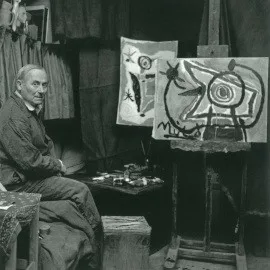
His work is influenced by the family home in Mont-roig del Camp (Tarragona); many of his early works are rural in nature, such as: La Masía, Vinyes i oliveres de Mont-Roig, Hort amb ase, La Vaileta, Poble i esglèsia de Mont-Roig del Camp…. Later, other cities like Paris, Mallorca, and later New York and Japan became the counterpoint to the artist's intellectual agitation and a significant influence on the creation of his works from the 1920s onward, alongside the surrealist poets and the stimulus of abstract expressionism he discovered in New York in the 1940s. During the Spanish Civil War, Joan Miró went into exile in France; later, during World War II, he left his exile in France and settled in Palma de Mallorca, a space of refuge and work, where his friend Josep Lluís Sert designed the studio he had always dreamed of.
A universal artist, a universal Catalan, an important and transcendental figure in the history of art, and practically the first graphic artist in history. Creator of a unique and highly personal language that places him as one of the most influential artists of the 20th century.
His works are appreciated by collectors worldwide and are therefore present in the most important galleries, museums, and prestigious collections.
Newsletter
Subscribe to our newsletter and receive all our latest news
Thank you!
Your inquiry was sent successfully. We will get back to you soon.